
.avif)
The success of wave pools has already proven that people are willing to show up. However, the question that actually determines long-term revenue is what happens after that first session.
Will the surfer come back and progress? Will they spend beyond the entry fee? Did they enjoy it enough to bring others along with them?
That gap between a one-off booking and a repeat customer is precisely what lifetime value measures, and it looks different for every segment of your customer base that walks through the door.
Research from Surf Park Central estimates that session revenue accounts for roughly half of total income for many operators. The rest comes from lessons, memberships, food and beverage, events, retail and private hire.
This essentially confirms that the session fee is merely the entry point instead of the target.
That same logic shows up in how the experience is run. Mike Goldys — aka Surf Park Nerd, with 35 wave pools surfed under his belt — says the venues that stand out from other operators must get every stage of the guest journey right.
This includes things like:
"When all parts of the experience are given attention, it shows," he says.
But this doesn’t happen on its own, and a full calendar can easily hide a weak LTV story: from a beginner with no reason to come back to an advanced surfer who'd rather pay more for a better wave format, a family that would book another night if someone offered, a local who wants more than a discount, or a tourist one conversation away from booking a full trip.
This confirms that the real question to ask about every booking that comes in isn't whether or not the slot gets filled, but what your business actually does with (and for) the surfer once they're on site.
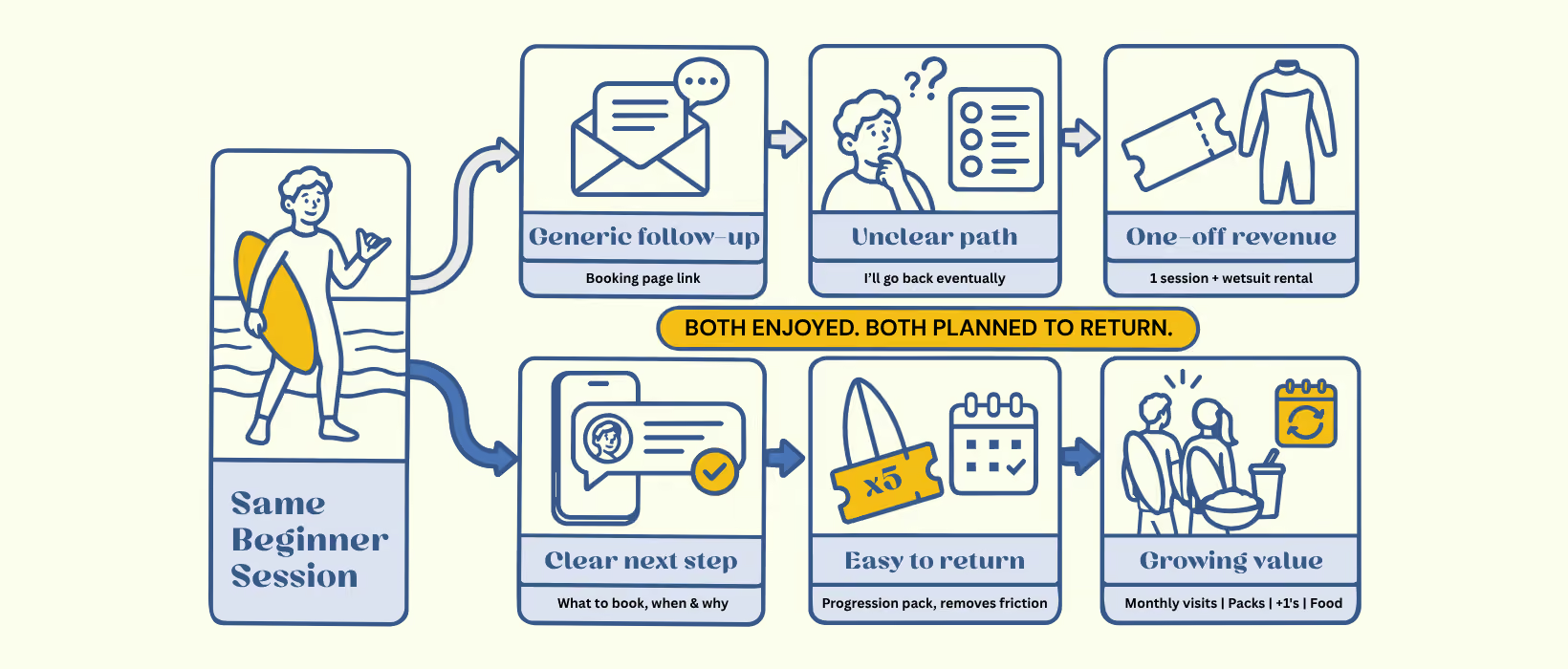
Picture two first-timers finishing the same beginner session. Both of them enjoyed it, and both say they'll come back.
The first gets a generic follow-up email and a link to the booking page with a generic list of sessions. Overwhelmed by the options, they put off deciding… and “later” becomes “never.” That surfer is ultimately worth one session and a wetsuit rental.
By contrast, the second gets a message telling them exactly what to book next, what they can expect moving forward, and why coming back within a few weeks will help them build on what they just learned. There’s even a progression pack that removes friction from the decision entirely. That surfer can become a monthly regular who buys packs, brings friends, and spends on food after sessions – essentially stacking up their value.
Giovanni Mancuso, Operations Manager at Surfland Brasil, has seen this play out for years: beginners who stick to a controlled environment usually progress steadily, especially if they have little to no ocean experience.
Marketing plays a role here too. Goldys flags that parks who mostly feature pros landing airs and barrels can undercut their own beginner pipeline, since viewers don't see themselves in that footage and assume the venue isn't for them.
After all, most beginners are often short on clarity instead of interest:
If you’re able to answer any or all of those questions before they have to ask, the second booking becomes an obvious next step.
Intermediate is the hardest level to manage in the water, since some surfers overestimate themselves and paddle into conditions they're not ready for. Especially in the ocean, where nobody’s around to gauge their level for them.
That said, it’s also where surfing gets genuinely fun. Once the basics are automatic, progress shifts from mere survival to chasing specific wins: a first cutback, generating speed instead of losing it, etc.
And those small wins are exactly what keep intermediates hooked, which makes them the highest-leverage segment for LTV. But what converts that motivation into revenue is whether or not the surfer knows what to work on next.
Understanding which session fits them, whether they're ready to move up, which board suits them now, and what to focus on today are all key factors in determining whether they come back.
That's where targeted offerings like a turns clinic, video analysis, a board demo, or a coach-led session built around one skill can do a large chunk of the work.
However, it’s important to not think of it as a beginner lesson repackaged. Instead, frame it as a nudge toward a win the surfer is likely already chasing. Because even though the motivation shows up on its own at this point, long-term revenue depends on having something concrete for them to work toward.
.avif)
With advanced surfers, the problem is less about explaining the product and more about finding ways to keep things interesting once they've surfed your usual lineup a few times.
Thankfully, there’s a simple way to break the routine and keep things engaging for customers who are past the novelty stage: limited formats create that value:
All of these experiences feel fresh and don’t require much extra build-out on your part. And since predictable programming is usually the main culprit that flattens demand for this group, leaning into scarcity, on a strong enough product, will give them something concrete to plan around.
Another option is tapping into in-session spend, which often comes from products that extend the moment. A surfer who just landed a move they've been chasing wants the clip of that specific moment so they can continue to relive it.
In cases like these, water shots and drone footage sell easily while the adrenaline is still there. Considering that in-house photo and video are underused according to Goldys, that's an easy win to capture.
Sure, AI capture tools like Flowstate and Surf Eye are useful, but there are plenty of surfers willing to pay for high-resolution stills or clips to share on social media. Plus, that content also equals free word-of-mouth for the venue, so it’s basically a win-win.
Finally, who they're surfing with also matters. Capping sessions by level or running a heat format that pushes similarly skilled surfers against each other can change the whole experience. For example, consider formats like a monthly challenge, a scored session with small prizes, or a friendly heat night.
Whatever you do, though, don’t make it overly serious. You want to give advanced surfers a reason to compete, watch each other, and stay longer… not alienate anyone.
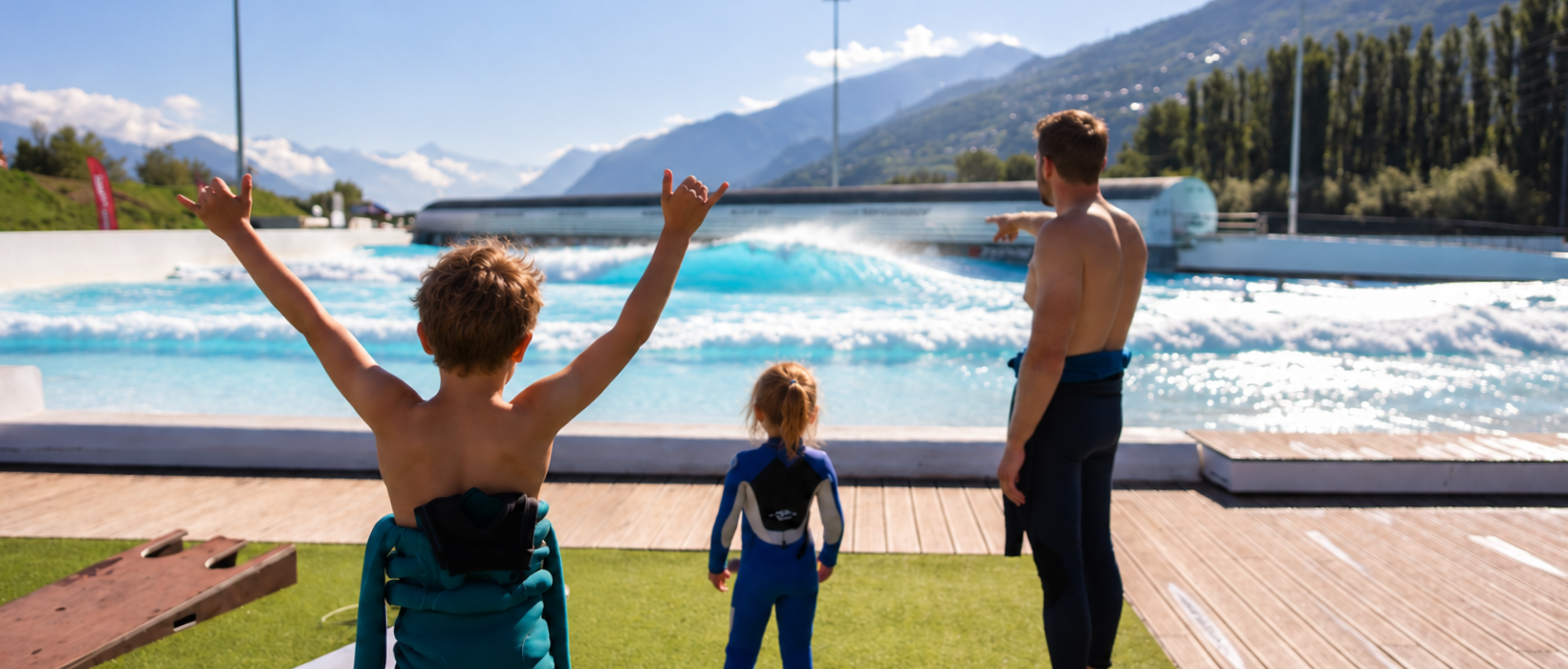
In the ocean, surfers disappear into the lineup while everyone else waits on the beach. A wave pool removes that gap. Since the wave is close and easy to watch, it can transform an entire visit into a family product instead of a solo one.
A parent can watch their kid's first wave from the terrace instead of squinting from two hundred metres out. A non-surfing partner has a reason to be there too — a good seat, a coffee, and a laid-back atmosphere that’s worth sticking around for.
This is where a handful of practical details and small touches can come in to do most of the work:
If you can package these into a clear family offer — surf sessions, the day's menu, a media upgrade for everyone — the visit gets a lot easier to plan and even easier to spend more on.
Similarly, a supervised kids' space is worth adding on its own. Knowing that their kid is looked after removes the barrier for parents who want to surf but need somewhere safe to leave a child nearby. Also, it's usually a feature that most parents are usually happy to pay extra for.
If you’re able to strike the balance between convenience and connection, your business becomes a repeatable answer to a weekend plan, a school holiday activity, or a birthday. Which is always better than a one-off outing.
In the ocean, surfers disappear into the lineup while everyone else waits on the beach. A wave pool removes that gap. Since the wave is close and easy to watch, it can transform an entire visit into a family product instead of a solo one.
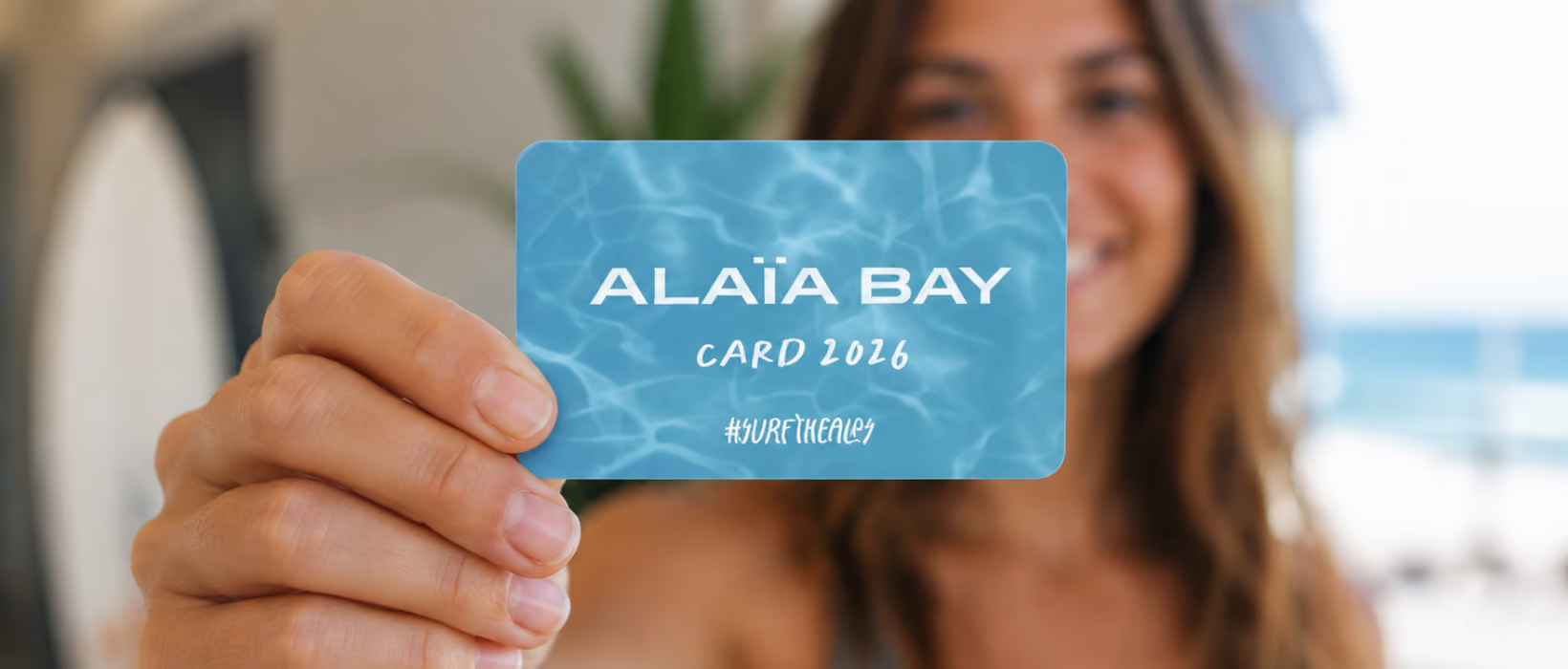
A local booking a Tuesday lunch session might look unremarkable on its own, but stretched across a season, that same person — racking up twice-monthly sessions, a membership, family visits, a season media package, coaching — is worth a lot more than most single tourist visits. Better yet, it fills up the slots tourists don't.
Mancuso points to the power of community as the harder-to-measure driver behind that value. Because even though surf culture has always had this, a park has the necessary structure to amplify it through proximity and regularity, both of which are much better shared instead of scattered across a beach.
"Regular groups form, people return together, and the venue becomes a place where the surf community grows around the water," he says. That sense of community is what drives repeat visits and word of mouth in a way that even the most aggressive media budgets can't buy.
For one, discounts are a key part of what makes membership worth it. But they're definitely not the whole pitch. What keeps a local coming back to you through a full season is the discount plus priority, consistency, recognition, and belonging.
A few instances where this plays out could be:
Each of these perks gives locals a reason to show up that goes way beyond a discount.
.png)
A travelling surfer typically arrives with more time, more intent, and more willingness to spend than someone who’s just squeezing in a lunch-break session.
So the question here isn't how to sell them one booking, but how to make the whole trip a lot easier for them to plan.
Left to figure out the details alone, a tourist has to decide on a handful of moving pieces, such as
Every single one of those unanswered questions is money left on the table as added value that the park doesn’t capture.
Creating packages helps close that gap by making the decisions easier for them, for example:
Goldys also points out that on-site extras, such as pools, walking paths, a skate park, or climbing, can help increase the odds that a paying customer will stay longer instead of simply treating the park as a single stop.
For parks with accommodation, the competition isn't just another wave pool — it's between a week in Morocco and a long weekend in Portugal. This means sessions, meals, media, retail, and time on-site all need to read as one complete stay rather than separate add-ons. Even without accommodation, hotel partnerships and curated weekend itineraries can help push the offer in the same direction.
And don’t assume that tourists have to come from far away to count. Someone just 20 minutes down the road can behave exactly like a tourist during a celebration weekend, or if they’re looking for an excuse to get away without going far.
In fact, that segment often converts a lot more easily because there's no flight or long planning window involved. All it takes is the right offer at the right moment, like a surf-and-dinner package or a couple's night built around the wave.
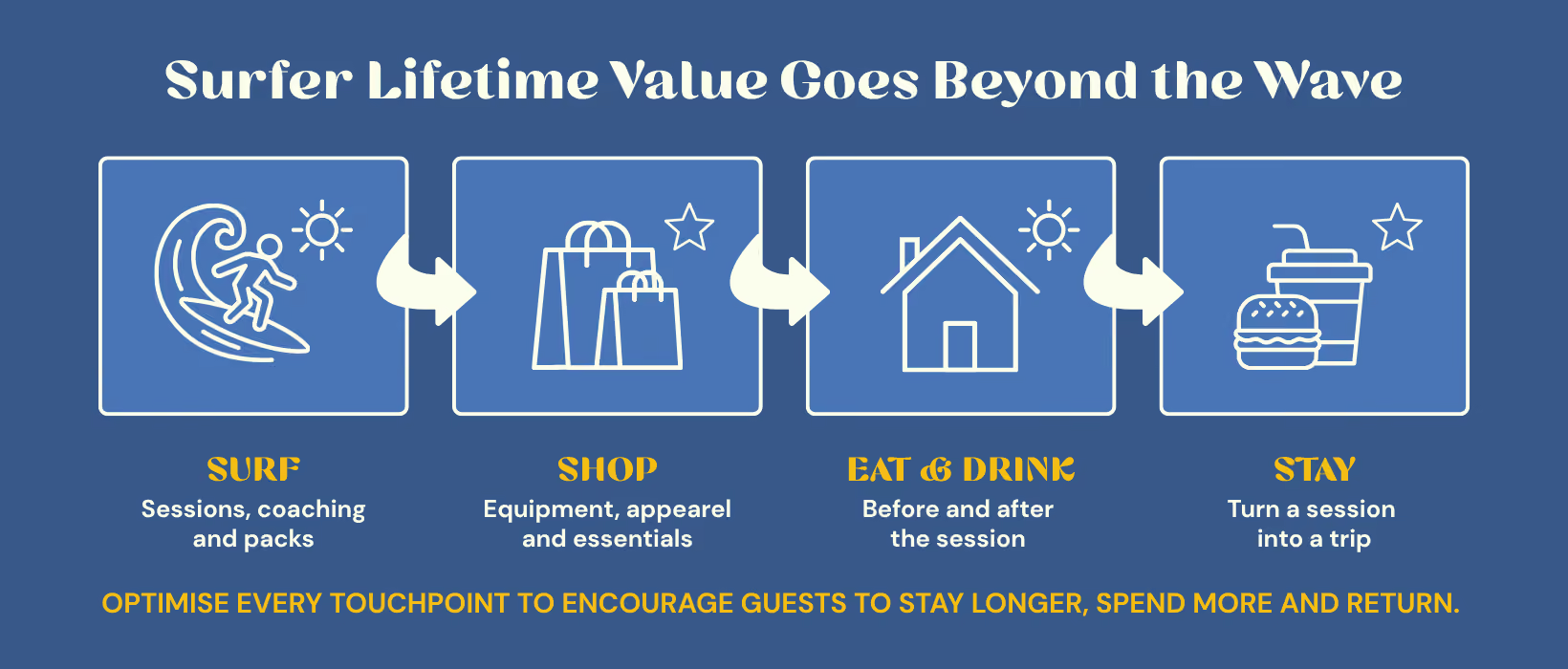
Segment-level LTV is only part of the picture. The rest compounds through what surfers spend once they're already on site:
The opportunity isn't just about having a restaurant on site. Instead, think of it more as matching the offer to how people actually use the venue. For example, a “pre-work surfer” wants coffee and something quick. Meanwhile, someone doing two sessions needs a proper recovery meal. Finally, a family on the terrace likely wants lunch and an easy place to wait.
Offering a surfer-specific menu, with items like pre-surf snacks, protein shakes, hydration, post-surf bowls, fills that gap directly.
In terms of operations, Goldys notes that when a booking spans multiple sessions, food and hydration can make or break the day. If a surfer has to leave the site to eat and come back, the park loses that potential F&B spend and, along with the hassle, adds friction to the whole visit.
Along with session-day F&B, weekly menus and afterwork events can extend this opportunity further while giving people a reason to show up on non-surfing days too.
People love to buy souvenirs from places that mean something to them whether or not they really need the item.
That instinct of tying a physical memento to a moment is exactly the case for a surf shop. Whether it’s a keepsake for a tourist, a cap a local can wear around town, or the T-shirt a kid wants after their first wave, most merchandise just has to be there to inspire a purchase.
The other half of retail is trust. Things like recommending the right board at the right moment tells a surfer you understand where they are in their progression. Similarly, beginners need the basics without overwhelm. And a few sessions in, the conversation shifts to fins, wetsuits and small upgrades – all of which they can conveniently find on-site.
As for advanced surfers, look for performance gear and brands they already trust that’ll hold up to what they expect and reinforce that trust.
If you’re able to get that sequencing right, the shop will stop feeling like a last stop before the car park and turn into a worthwhile space that adds to the day instead of closing it out.
If you're still building a park, you can use this guide as a blueprint that’ll save you from playing catch-up further down the line. The first step toward designing for retention is understanding that beginner, intermediate, and advanced surfers, as well as families, locals, and tourists each need a different reason to return. Once you know what each group is looking for, it's a lot cheaper to design the follow-ups, packages, and community pieces from the beginning than to try and bolt them on later.
If you're already operating, this same structure can serve as a quick gut check. In order to see where you stand, simply pull your numbers from the last few months and break things down segment by segment, asking yourself questions like:
The wave gets people through the door once, but what happens across these segments and in between visits is the deciding factor that’ll determine when (or if) someone decides to come back.
And at the end of the day, that margin is what truly drives LTV in the long run.
.avif)